
Get A Quote
My Account

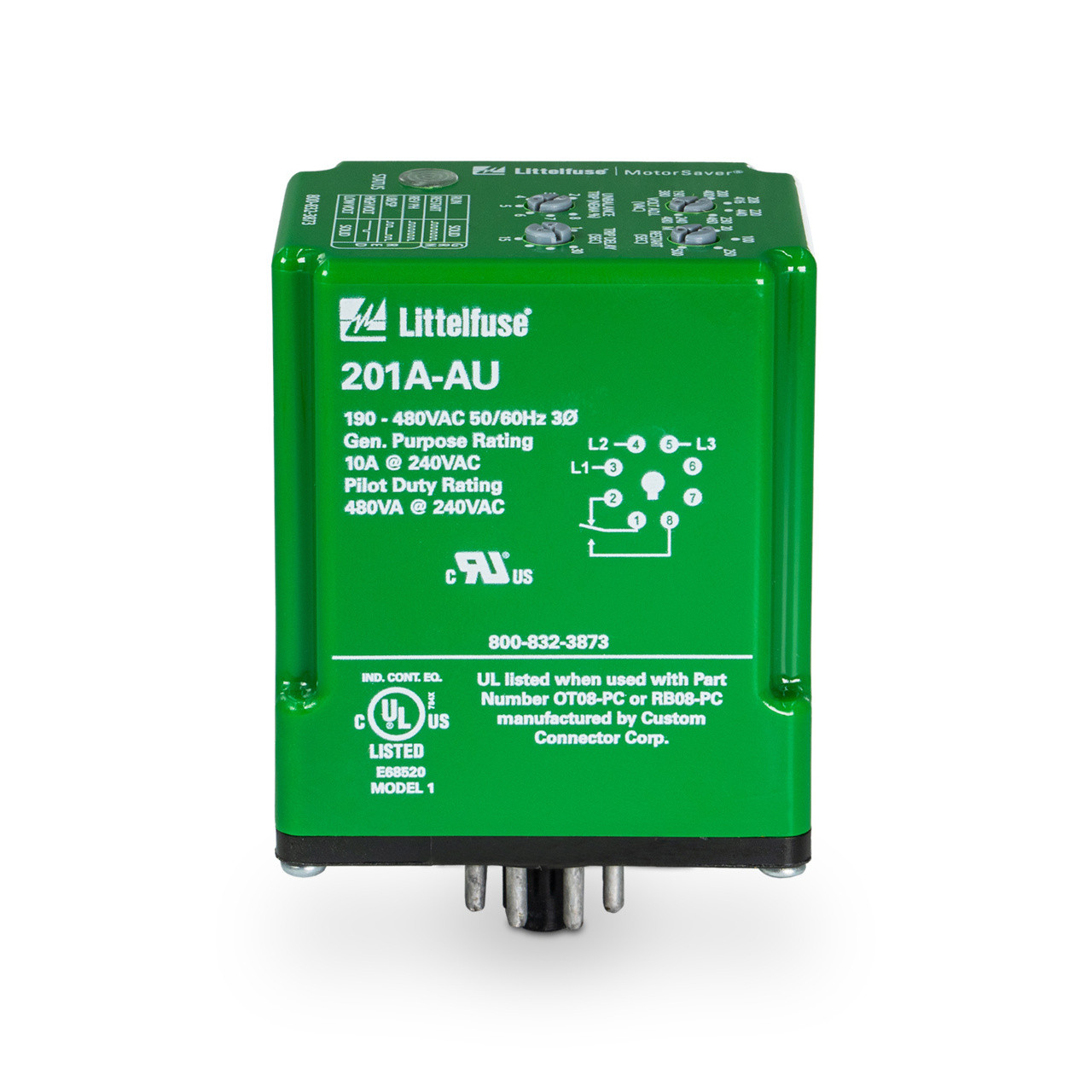


To ensure accuracy, please note that images may be representative. Refer to the product data sheet for detailed specifications.
| Manufacturer | Symcom / Littelfuse |
| Manufacturer Product Number | 201A-AU |
| Description | Voltage Monitor Relay; Lo/Hi V, Unbal, Loss, Rev; 190-480 VAC; TD 1-30s adj |
| Datasheet | Download Datasheet |
The Littelfuse SymCom 201A-AU is a 3-phase voltage monitor for 190-480 V AC motors. It protects against low voltage, high voltage, voltage unbalance, phase loss and phase reversal. It auto-ranges between its 200 V and 400 V ranges against a user-selectable nominal setpoint.
Trip / reset points: low voltage 90% / 93% of setpoint (±1%); high voltage 110% / 107% of setpoint (±1%); voltage unbalance 2-8% adjustable / trip setting minus 1% (5-8%), minus 0.5% (2-4%) (NEMA).
Trip delay: 1-30 s adjustable (high, low, unbalanced voltage); 1 s fixed for single-phasing faults. Restart delay: Manual or 1-500 s adjustable (after a fault or a complete power loss). Reset: Manual or automatic. Accuracy: ±1%. Diagnostics: Single LED diagnostics (cause of trip).
Output: 1 Form C (SPDT), 10 A @ 240 VAC general purpose. Mounting: Plug-in; DIN rail or surface mount on OT08PC socket, 8-pin octal plug-in. Dimensions: 44.45 x 60.33 x 104.78 mm (1.75 x 2.38 x 4.13 in), H x W x D with socket.
It operates from -40 to +70 °C and can be stored from -40 to +80 °C. Approvals: UL 508.
| Category | |
| Manufacturer | Symcom / Littelfuse |


